
Surfboard Propulsion System to Facilitate the Catching of Waves
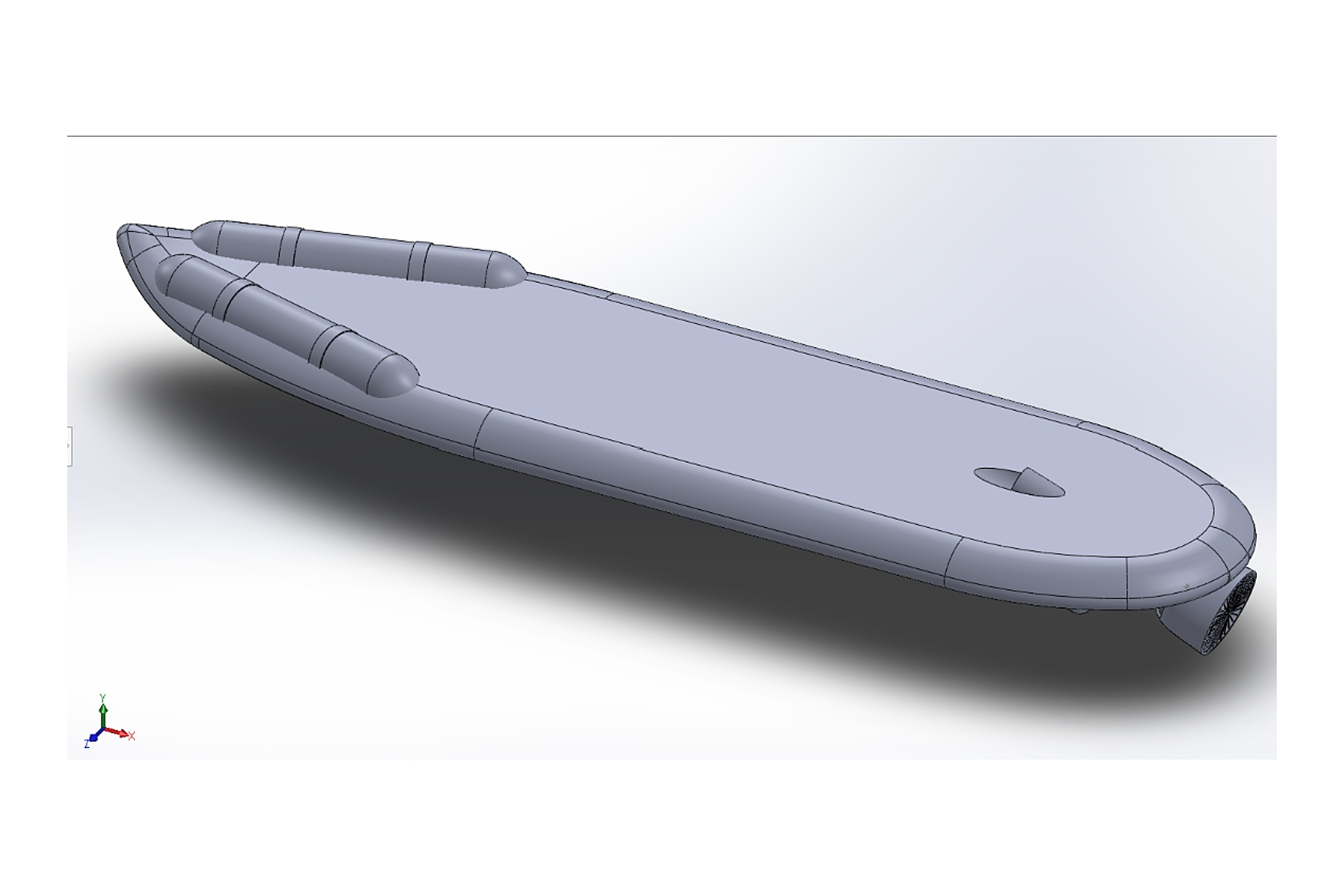
There is a large demand for beginner surfboards that lower the level of skill needed to surf due to the sport's increase in popularity. Despite surfing's big increase in popularity, one of the biggest challenges for beginner surfers is the difficulty of catching a wave. Surfers need to have exceptional upper-body strength, endurance, and technique when catching a wave. Beginner surfers tend to have difficulties picking up the sport because of this, which can then lead to them quitting the sport out of frustration and potentially causing safety hazards in crowded waters. Our project proposes a solution to this problem. A surfboard equipped with a pneumatic propulsion system that provides a short, controlled burst of thrust will help beginners match a wave's speed during takeoff. A pneumatic propulsion system can be simple, light, and environmentally-friendly, while not changing the traditional process of surfing in a major way. In order to qualify our design as an overall success we will be using metrics of velocity and non-trivial system usage time aiming to replace 75% to 100% of a surfer's physical requirements in order to catch a wave. For velocity we set the most favorable goal as being able to accelerate from rest to 2.5 m/s in calm water, this is on average the typical wave speed a beginner level surfer would encounter and have to match in the ocean. We wish to achieve this velocity within 5 seconds of engaging our system, using an average user weight of 80 kg. We found that this would require at least 90 N of force to overcome the inertia of the mounted surfboard as well as the drag experienced at higher speeds. The pneumatic propulsion system is composed of three subsystems. These subsystems are air storage, pressurization, and propulsion. The air storage subsystem consists of two 1.5-gallon aluminum tanks that will be pressurized to about 150 psi. The propulsion subsystem is where stored pneumatic energy is converted into thrust. The main part of this subsystem is a pneumatic drill that can reach up to 22,000 rpm with a power rating of 0.5 hp. The chosen propeller has a 5 inch diameter with a 7.5 inch pitch. The shroud performs protective and environmental functions. While we are still awaiting results from our tests, we expect to hit the metrics mentioned previously. We will do this by testing the board in pools to measure its thrust and speed. Through this project, beginner surfers can finally have a reliable way to pick up the sport of surfing.