
Accessing a Lunar Lava Tube through a Motorized Airlock System
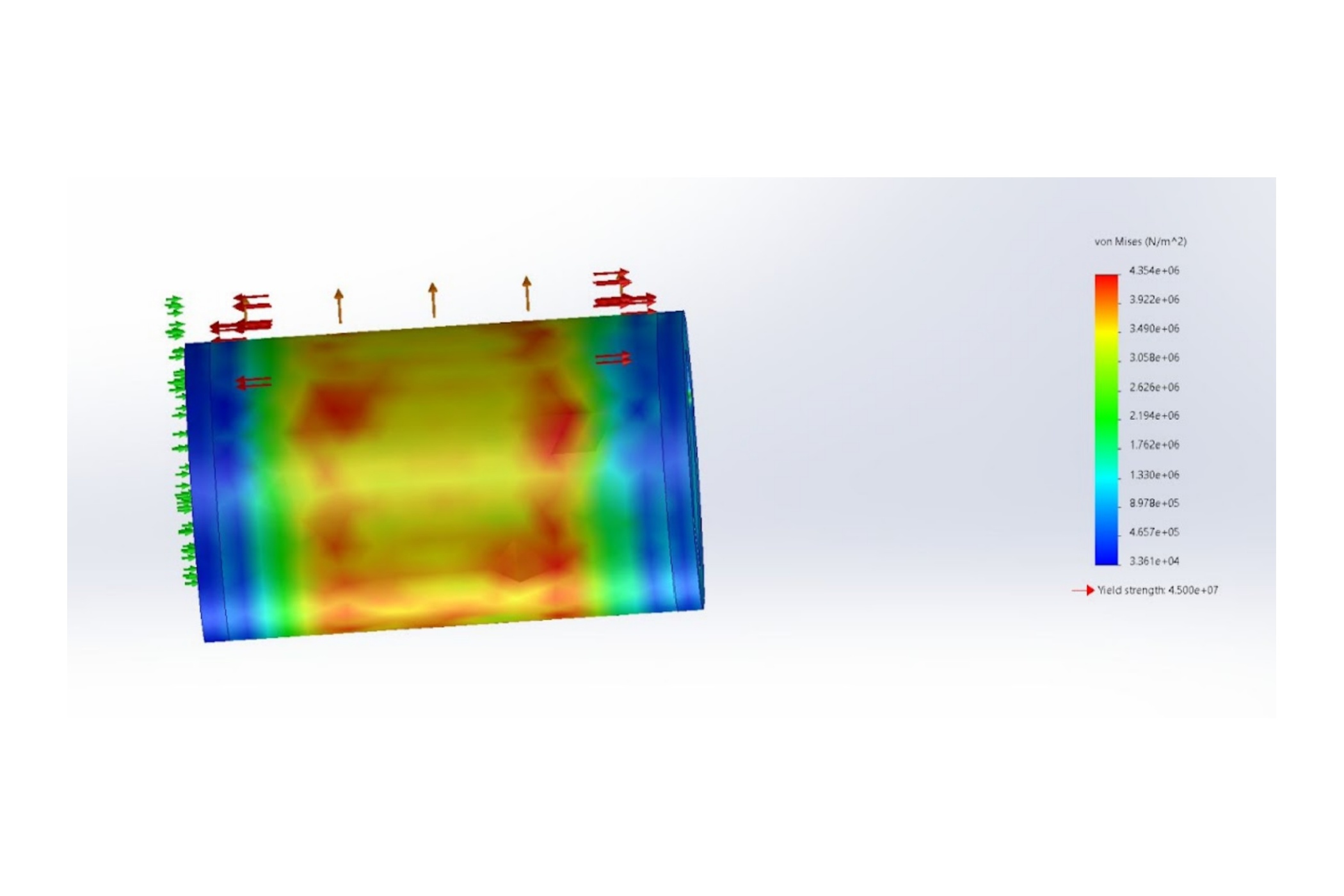
As humanity plans for sustained lunar habitation, a critical engineering challenge is to enable safe, repeated transitions between a pressurized habitat and the vacuum of the lunar surface. To do this, an airlock system is required to maintain the integrity of the habitat, resist contamination against regloith, and operate reliably. Other airlock systems tend to be more mechanically complex and difficult to service, so this project aims to target both of these points. This new airlock ensures failsafe operation to ensure that both doors are not allowed to be open simultaneously which would cause rapid depressurization and endanger everyone in the habitat. In addition, the simplified design allows for easy manufacturability and repair under resource-constrained conditions. Three different design iterations were discussed, each comparing structural integrity, ease of manufacturing, and safety performance. Thin-wall hoop stress calculations were done to verify that the plexiglass airlock cylinder could accommodate for a range of pressure differentials. The ideal gas law was used to ensure the chosen pump could accommodate the needed pressurization. Solidworks simulations were run across four different pressure differential settings to ensure no deformation would occur. Given the constraints and criteria the project accounted for, a final design consisting of a cylinder and a rectangular chamber was chosen in which a pressure differential would be created between the cylinder and the chamber with pressurization valves equalizing the increased pressure, and exposing the cylinder to base atmospheric pressure prior to opening of the door to lunar surface. In performing all the calculations and simulations, the maximum hoop stress in all pressure differentials remained below the theorized yield strength of the plexiglass of 45 MPa. In addition, all simulations proved all hand calculations to be accurate in failing to surpass the final yield strength. Physical construction of this project was focused on during the spring semester with the team validating the logic of both the servo motors and solenoid valves, to ensure functionality of doors and pressurization of the chamber, and machining and manufacturing of the entire project. This project allows a new outlook on existing airlocks allowing for a practical, repeatable concept that can be easily applicable to lunar habitats despite complexity and access to materials. In simplifying the actuation functions and selecting materials that are consistent with NASA guidelines for pressure vessels, the design demonstrates safe airlock functionality can be achieved with limited resources. The failsafe door mechanisms put inhabitants' safety at the forefront of the project and any future iterations.