
Sustainable Urea Production through Utilization of Bioethanol-Derived CO2
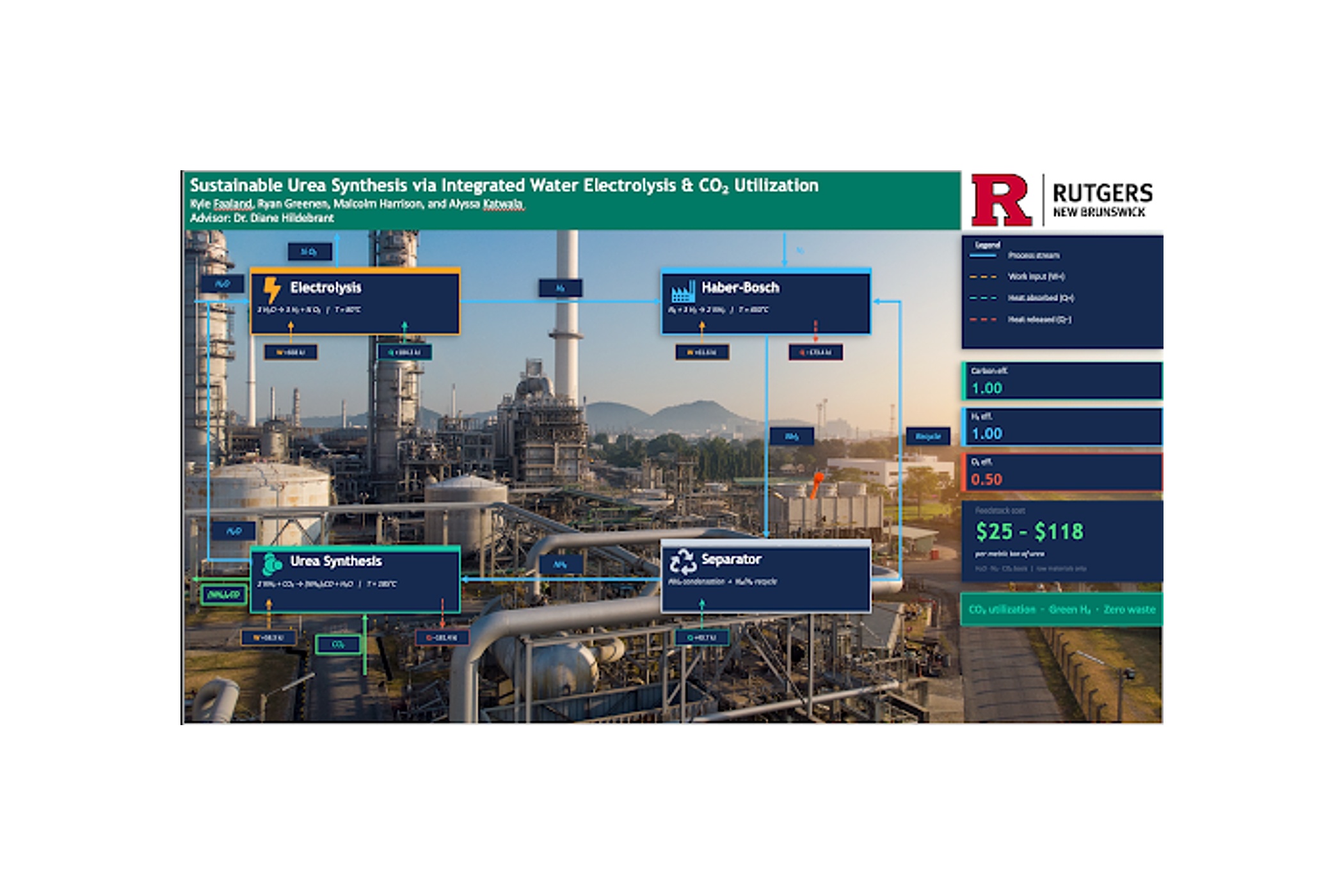
The growing need to mitigate climate change has driven interest in developing more sustainable pathways for the production of essential chemicals. Urea, a widely used nitrogen-based fertilizer, is conventionally manufactured using fossil fuel-derived feedstocks, resulting in substantial carbon dioxide emissions. This project investigates an alternative process that integrates carbon capture and utilization by converting CO? into urea using renewable inputs.
By coupling CO? sourced from bioethanol production with hydrogen generated through water electrolysis, the proposed design aims to reduce dependence on fossil fuels while maintaining industrial relevance. The process converts water, nitrogen, and carbon dioxide into urea through a sequence of well-established chemical reactions. Hydrogen is first produced via electrolysis, enabling a transition away from conventional hydrogen production. This hydrogen is then reacted with nitrogen to form ammonia through the Haber-Bosch process, a critical intermediate step. The ammonia subsequently reacts with CO? in a urea synthesis reactor, forming urea through an ammonium carbamate intermediate.
The system is structured into three primary subsystems: hydrogen generation, ammonia synthesis, and urea production. Each subsystem operates under conditions selected to balance reaction kinetics, thermodynamic limitations, and overall process efficiency. Separation units are incorporated to recover unreacted species and recycle them back into the process, improving conversion and minimizing waste. Additionally, water produced during urea synthesis is recycled to the electrolysis unit, supporting a closed-loop design that reduces material losses and environmental impact.
Energy integration plays a key role in the process design. While certain reactions are exothermic and provide opportunities for heat recovery, the process remains energy intensive due to the electrical demand of electrolysis and the work required for gas compression. As a result, overall sustainability depends heavily on the availability of low-carbon electricity. When paired with renewable energy sources, the process has the potential to significantly reduce lifecycle emissions compared to conventional urea production methods.
From an economic standpoint, the primary challenge is the high energy demand associated with hydrogen production. Although this limits current competitiveness, advancements in electrolysis technology and renewable energy infrastructure are expected to improve feasibility.
This project demonstrates how traditional chemical processes can be re-envisioned through process integration and sustainable design, providing a viable pathway toward lower-emission fertilizer manufacturing.