
Functionalizing Fibers Using Electrospray Desposition
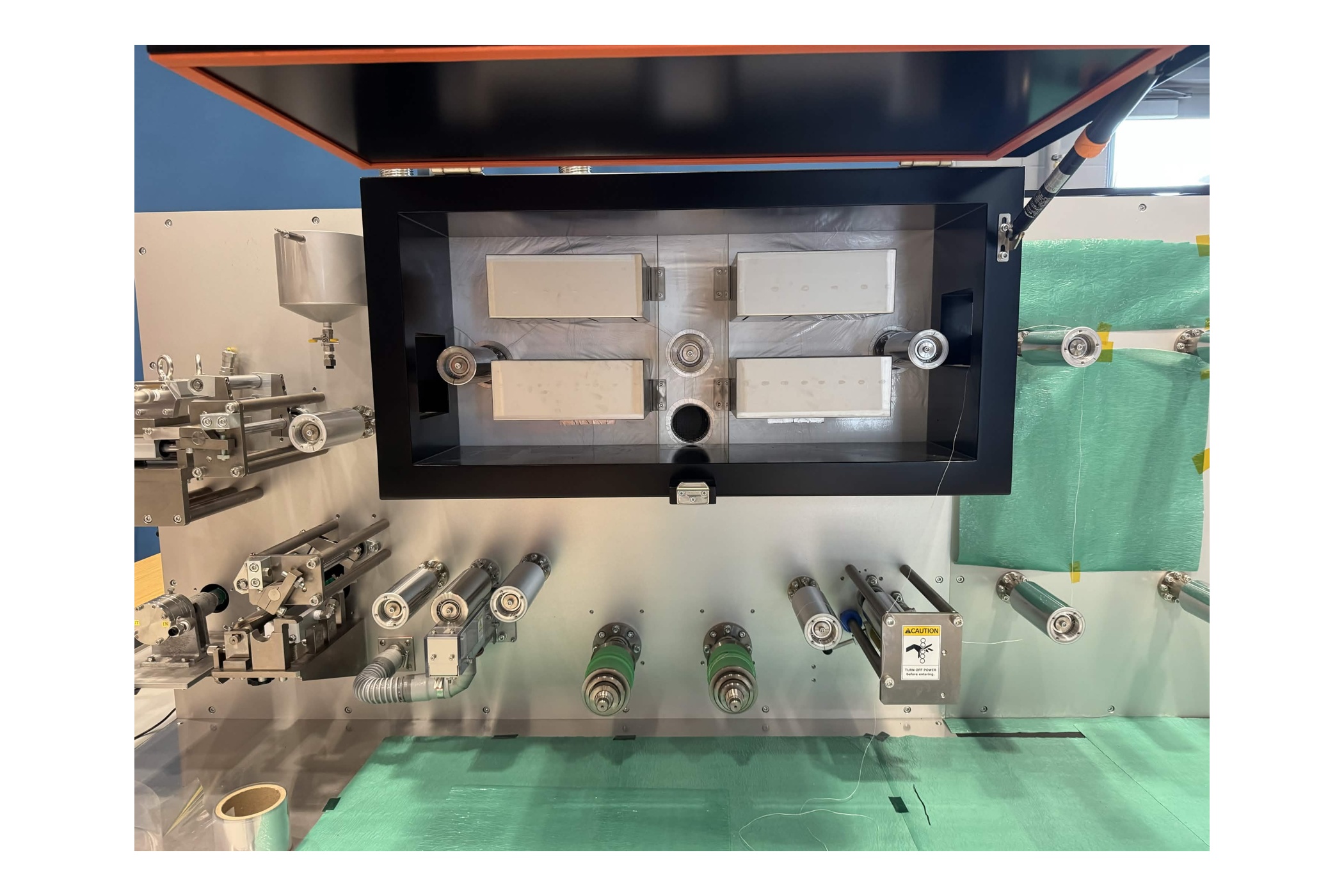
Roll-to-roll (R2R) dip-coating is a continuous manufacturing method used across textiles, healthcare, and energy industries to apply functional coatings to flexible substrates. However, dip-coating requires immersing the substrate in a full solution bath, resulting in significant material waste, as the majority of the coating solution goes undeposited. This inefficiency is particularly costly when working with expensive or scarce treatment materials such as super-activated carbon or specialty polymers. This project addresses the waste problem by integrating electrospray deposition (ESD) into an existing Yasui Seiki MiniLabo Deluxe R2R machine, replacing the chemical bath with a precision nanoscale coating process. In ESD, a high-voltage electric field atomizes a polymer solution into micro- and nanoscale droplets that deposit directly onto a grounded fiber substrate, producing uniform thin-film coatings with virtually zero solute waste. A central challenge of this integration is that the R2R heating chamber contains four 3.0 kW MISUMI hot air generating units and three steel guide rollers, all of which are electrically conductive and could interfere with the high-voltage electrospray plume. To solve this, the team designed and fabricated a three-walled acrylic isolation enclosure that fits inside the existing chamber without permanent modification to the machine. The enclosure electrically separates the spray region from the surrounding metal components while maintaining optical transparency for real-time monitoring of the deposition process. A three-dimensional conjugate heat transfer simulation was performed using Ansys Fluent, confirming that air velocity in the needle region remains well below the threshold that would destabilize the electrospray Taylor cone. Additionally, a fiber wetting station was developed to improve coating adhesion. The system is now entering the testing phase, with immediate goals to demonstrate stable electrospray operation on a continuously moving fiber and to produce functionalized samples using super-activated carbon. The successful integration of ESD into an existing R2R platform establishes a scalable, low-waste manufacturing pathway applicable to carbon filtration media, protective textiles, and biomedical fiber coatings.