
Machines for Testing the Mechanical Strength of Additive Manufactured Parts - Group 3
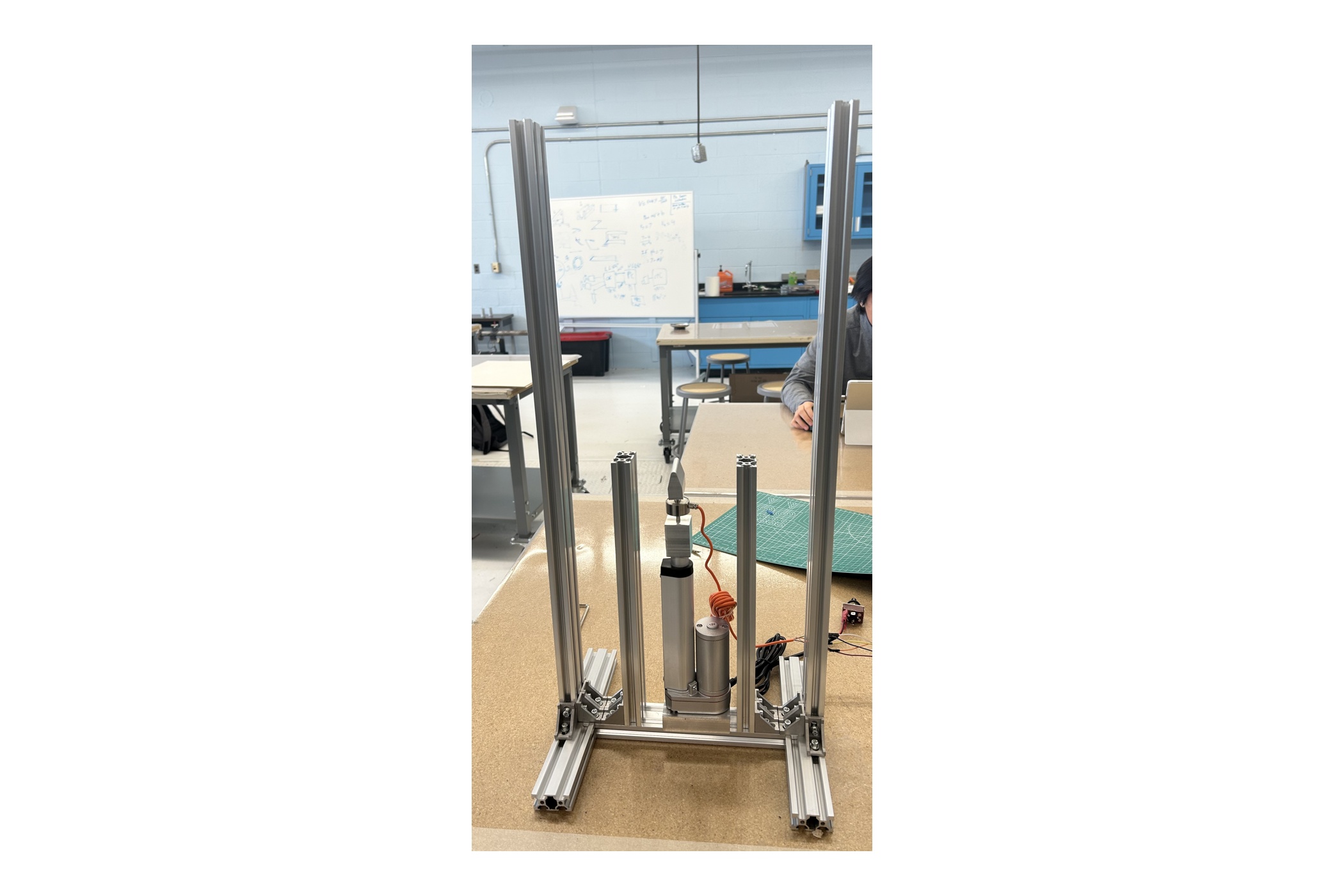
Project Motivation and Problem Statement The rapid adoption of additive manufacturing (AM) has introduced significant challenges in material reliability, particularly with fused deposition modeling. Unlike traditionally manufactured parts, AM products exhibit anisotropic properties, meaning their strength varies based on print orientation. Internal defects and varying infill patterns can reduce tensile strength by up to 50% compared to traditional materials. While mechanical testing is essential to ensure safety, commercial Universal Testing Machines (UTMs) are prohibitively expensive, with entry-level models costing between $12,900 and $30,000. This high cost creates a significant barrier for small-scale manufacturers and educational institutions. Group 34 is addressing this gap by developing a low-cost, reliable testing machine specifically designed to characterize the flexural properties of AM polymer parts. Engineering Approach and Methods The team developed a compact 3-point bending test device in accordance with ASTM D790 standards. The engineering approach prioritized structural rigidity, load accuracy, and manufacturability. The design utilizes a two-column aluminum V-slot frame featuring an inverted architecture to lower the center of gravity and improve access to electrical subsystems. Extensive SolidWorks simulations were conducted on critical load-bearing components—including the anvil, connection block, and frame members—to ensure they withstand the maximum produced force of 1000 N without undergoing plastic deformation. Material selection was validated through these simulations, leading to the use of Aluminum 6061-T6 and 6063-T5 for specialized fixtures. Design Implementation The prototype consists of four primary subsystems: mechanical, sensor and data acquisition, control and processing, and output. Mechanical: A 4-inch-stroke linear actuator applies a controlled load to 3D-printed PLA specimens. Sensors: A high-precision compression load cell and a digital dial gauge measure force and deflection, respectively.Control: An Arduino Uno processes sensor signals to compute Young's modulus and flexural modulus in real time.Output: Dual LCD displays provide immediate user feedback. To ensure operator safety, the frame is enclosed in a clear plastic cover to protect against debris and pinch points. Results and Performance Evaluation Detailed design and engineering analyses are finalized and validated. Static simulations confirmed the structural integrity of the V-slot bars, which showed a maximum displacement of only 0.0127 mm (0.0635% of thickness) under full load. The machine is estimated to cost less than $500, representing an 85-93% reduction compared to commercial alternatives. Preliminary testing strategies have already resulted in design optimizations, such as doubling specimen thickness to 0.25 inches to ensure a machinable 4-inch support span compliant with ASTM D790. Impact and Applications This project provides an affordable solution for small businesses and research labs to verify the performance of safety-critical 3D-printed components. Beyond its economic advantages, the project promotes environmental sustainability by enabling manufacturers to optimize infill patterns, thereby reducing material waste while maintaining structural integrity. Furthermore, it serves as an educational tool for teaching students about international testing standards, finite element modeling, and data acquisition.