
Design of Strong and Lightweight Spherical Pressure Vessel Using Carbon Fibers and Epoxy Resin
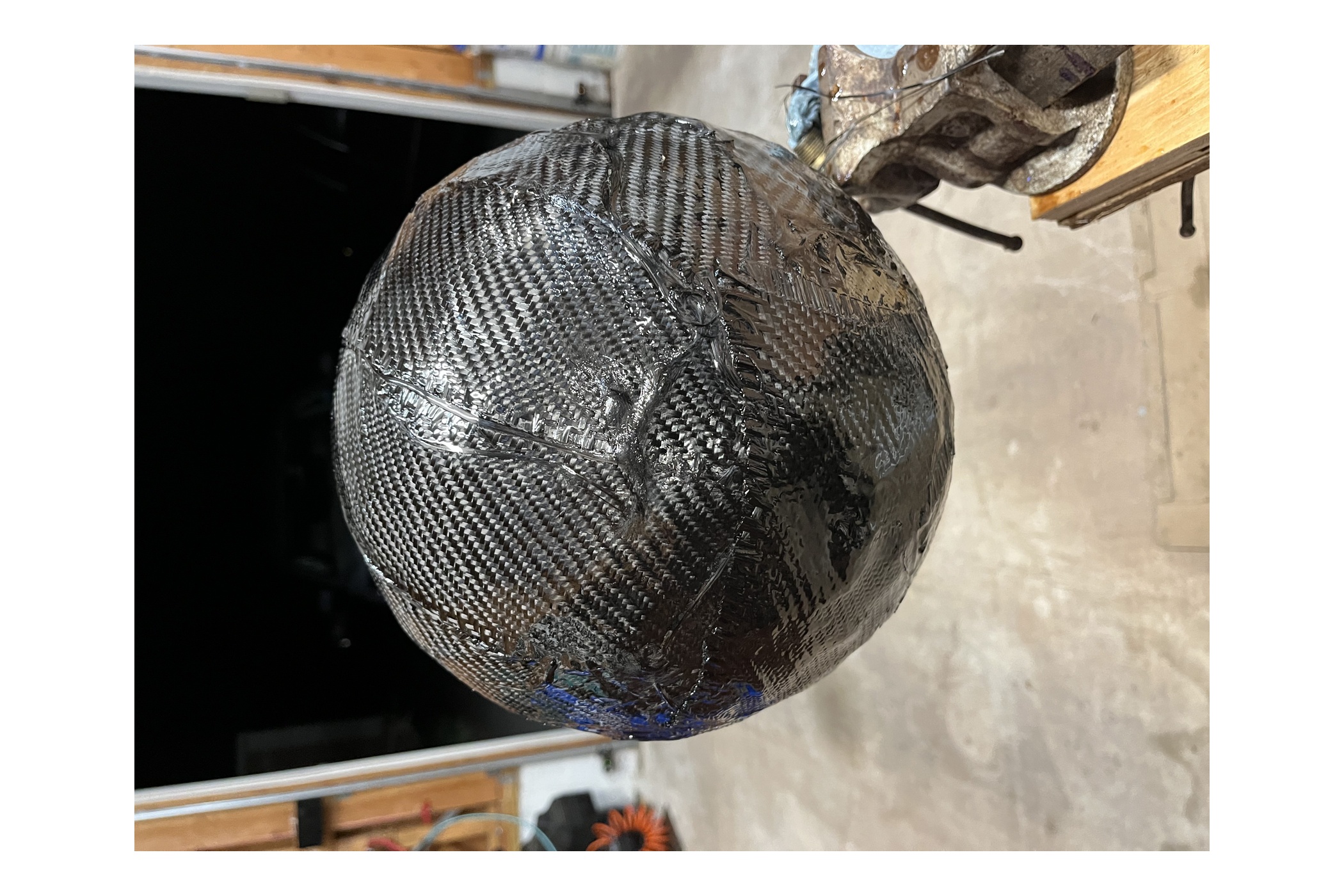
Pressurized vessels are critical in industries such as aerospace, energy, chemical processing, and medical technology, where safely containing high-pressure fluids is essential. Early designs relied on riveted plates and low-strength steels, which limited pressure capacity and raised safety concerns due to brittle materials and weak joints. While modern materials and manufacturing methods have improved performance, achieving high pressure capacity while minimizing weight and maintaining safety remains a key engineering challenge. This project focuses on a spherical pressure vessel made from a rigid 3D-printed PLA liner and a carbon fiber–epoxy outer shell. The liner consists of two mating hemispheres with a notched equator for alignment and assembly. The outer layer uses 3K 2x2 twill weave carbon fiber combined with marine-grade epoxy, similar to Type IV composite overwrapped pressure vessels that use polymer liners produced through additive manufacturing. The design goal is to withstand an internal pressure of 500 psi. Stress distribution and deformation are analyzed using ANSYS to evaluate structural performance. Because the vessel is spherical, the valve insert region (1/8") is a likely stress concentration point. To address this, an aluminum insert is used to help distribute stresses more evenly, and the surrounding area is reinforced with additional carbon fiber. A smaller valve opening also improves pressure retention. To analyze stresses in the carbon fiber shell, the vessel is treated as a thin-walled sphere, which is valid when the thickness-to-diameter ratio is less than 1/20. Under this assumption, hoop stress is dominant and can be calculated using Pr/2t. For this design, the hoop stress is approximately 20.83 ksi with a carbon fiber thickness of 0.06". Radial stress is much smaller and can be approximated as the internal pressure. Material failure is evaluated using von Mises stress based on the principal stresses in the vessel. Since carbon fiber is anisotropic, its properties vary with fiber direction, which is accounted for using a stiffness matrix that includes longitudinal and transverse behavior along with Poisson coupling effects. To validate the design, a hydrostatic test is conducted using a water pump to safely reach the target pressure. The final prototype includes a 1/8" NPT valve with an aluminum insert and a five-layer carbon fiber wrap. Simulation results show greater deformation near the valve region, which is expected and addressed through reinforcement. The total deformation plot indicates a small expansion of about 1.5 × 10⁻⁵ m, primarily near the top of the vessel. Both von Mises and principal stress plots show higher stresses around the nozzle and neck area due to the geometric discontinuity, while the rest of the sphere maintains a relatively uniform stress distribution. Overall, the results suggest the design performs as intended under the target pressure. Carbon fiber composites offer clear advantages, particularly in reducing weight and improving efficiency in applications like aerospace and hydrogen storage. However, they also present challenges, as production is energy-intensive and recycling remains limited. Improving sustainability will require advances in recyclable resins, bio-based epoxies, and carbon fiber recovery methods. Future improvements could include embedding sensors into the vessel for real-time structural health monitoring, as well as exploring hybrid or nano-reinforced composites to increase strength while reducing material use. Better recycling processes and circular manufacturing approaches will also be important for long-term sustainability. Overall, this project demonstrates a lightweight, high-performance pressure vessel design with potential applications in energy, transportation, and advanced engineering systems.