
Manufacturing Negative Poisson's Ratio Structures
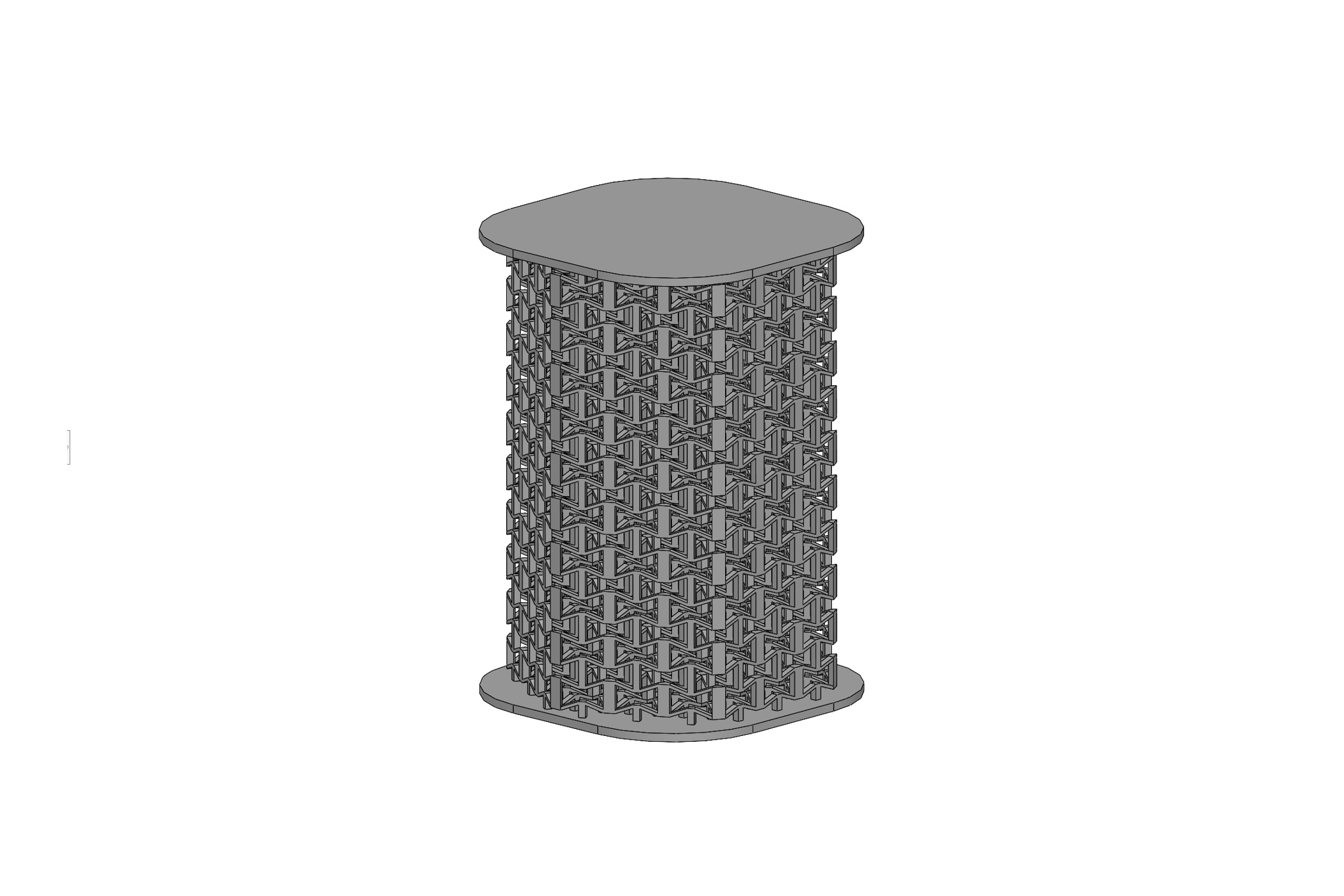
Materials exhibiting a negative Poisson's ratio, or "auxetic" materials, offer desirable properties in energy-absorption applications. In response to an impact, they locally increase in density at the impact site while remaining at their original density elsewhere, resulting in lightweight and dynamic materials. In addition to their weight advantage, they can outperform traditional absorbent materials. Applications include ballistic and sport protective gear, automotive passenger safety, and resilient infrastructure. Manufacturing auxetic structures is challenging using conventional methods and requires novel approaches. This project evaluates three manufacturing methods for their feasibility in producing auxetic structures at scale. The first method is additive manufacturing. Once an auxetic unit cell design is selected, a lattice (2D or 3D) is constructed in CAD and printed using an elastic material. The second method is treated foam, where foam becomes auxetic once its cells permanently invert and can unfold in tension. This can be achieved by softening the cell members with heat or chemicals. The third method is sheet folding, or origami, where materials like paper or metal are folded into patterns that exhibit a negative 2D Poisson's ratio. Stacking multiple sheets creates a larger structure. Each method is qualitatively evaluated for ease of manufacturing and consistency, while quantitative testing includes tensile tests for Poisson's ratio and drop deflection tests. Additive manufacturing uses an inverted hexagon unit cell and thermoplastic TPU. Non-bending members are designed thicker to allow printing with a single flexible material. Foam treatment involves heating polyurethane foam under bi-axial and tri-axial compression, then cooling it to retain inverted cells. The origami approach uses a chevron unit cell pattern, though large-scale production is limited due to unavailable equipment. Testing is ongoing for additive manufacturing and treated foam using drop tests and tensile tests. Drop tests measure vertical deflection after impact, with auxetic structures expected to show reduced deflection compared to conventional counterparts. Tensile testing measures Poisson's ratio, where negative values indicate auxetic behavior. While promising, scaling these methods presents challenges. 3D printing is limited by printer size, foam processing may not uniformly compress large samples, and large-scale origami requires specialized machinery. Future work should explore these limitations and expand testing methods.