
Jet Milling of Silicon Carbide: Particle Size and Surface Oxygen Evolution
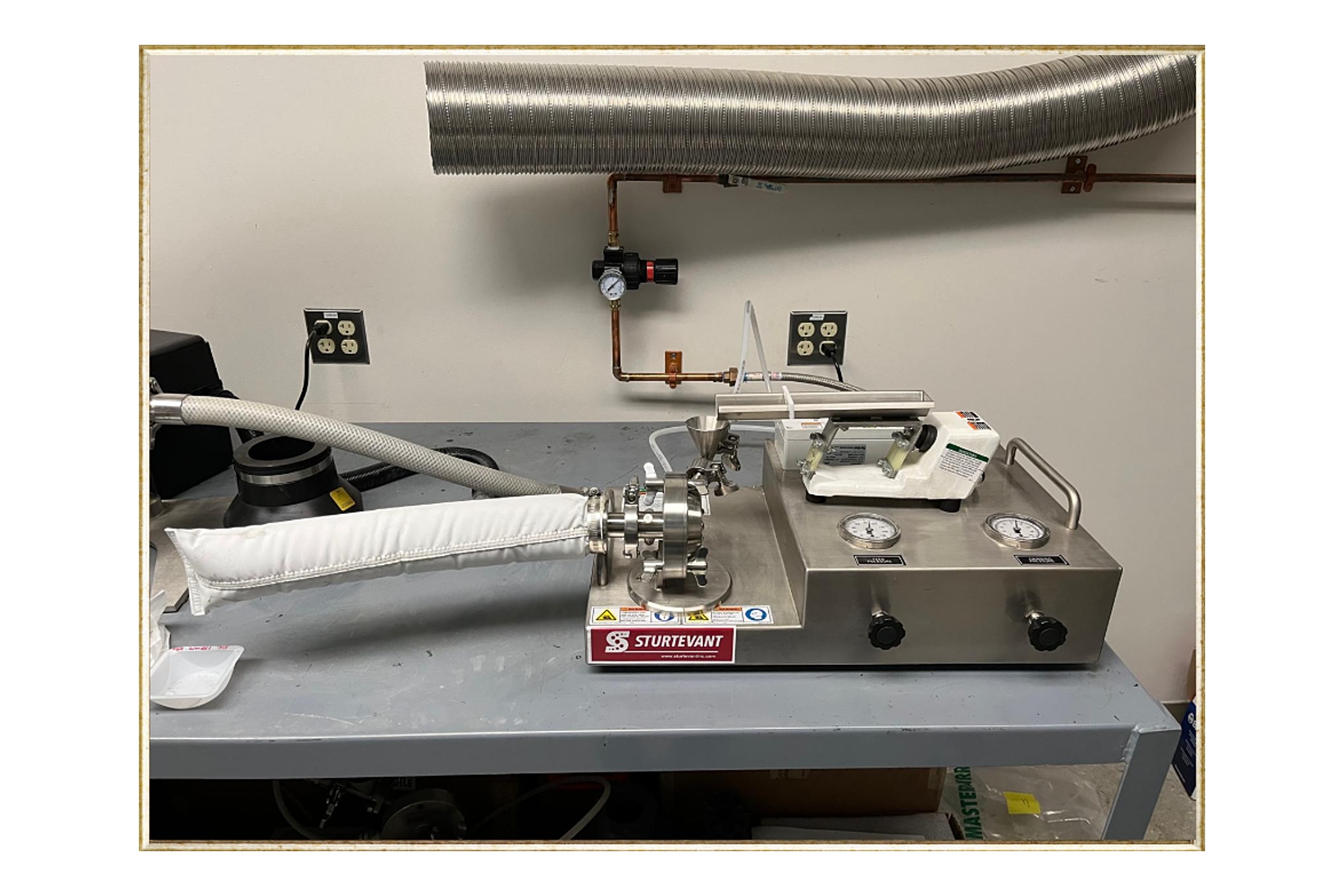
Silicon carbide (SiC) is a key engineering ceramic for high temperature and extreme applications due to its exceptional hardness, thermal conductivity, and corrosion resistance. These properties make it useful in components such as armor, semiconductors, and high temperature equipment. Achieving these desired properties in the final bulk component requires sintering to near theoretical density, which depends largely on powder characteristics such as particle size, distribution, and chemistry. Silicon carbide powders must be fine enough to densify efficiently, but also maintain low surface oxygen content. This creates a processing problem as the same high energy milling used to reduce particle size can also increase the surface oxygen content on the powder, thus interfering with densification. This project aims to understand this relationship in commercial SiC powders. The main goal of this project is to study how particle size distribution and surface oxygen content change as silicon carbide powder is reduced through high energy comminution. Three commercial silicon carbide powders with different starting size ranges were first characterized in the as-received state. The powders were then processed in a Sturtevant 2 inch open manifold jet mill, where compressed air is used to induce high velocity particle-particle collisions and fracture the powder, reducing particle size. Upon milling, surface oxygen content was measured using an oxygen/nitrogen analyzer, particle size distribution was measured using laser diffraction, and powder morphology was examined using field emission scanning electron microscopy (FE-SEM). This project was designed as an experimental method to compare as received with milled powders over multiple milling cycles. It allowed for the successful tracking of particle size, distribution, shape, and oxygen content changed over repeated milling cycles. The experiment also proved the viability of jet milling silicon carbide to sub-micron size under air without too much surface silica growth. The results show that jet milling caused a very large and rapid reduction in particle size. For the coarse silicon carbide powder, the median particle diameter dropped from 168 µm to 2.7 µm after one cycle. Surface oxygen content was measured upon milling and an increase from 0.174 weight % to 0.318 weight % was observed. The results indicate the expected tradeoff, jet milling is effective at reducing particle size, however the finer the powder becomes, the more surface oxygen growth becomes a concern. Recording these measurements will give ceramists an idea of the particle sizes and oxygen contents they can achieve with SiC using jet milling with air. Overall, this project helps build a better understanding of milling parameters and information for commercial grade silicon carbide powders before sintering. Ceramists can use this to guide future work on SiC densification, powder processing, and even other ceramic carbide/boride systems.