
Intelligent Smart Navigation System for Real-Time Path Optimization
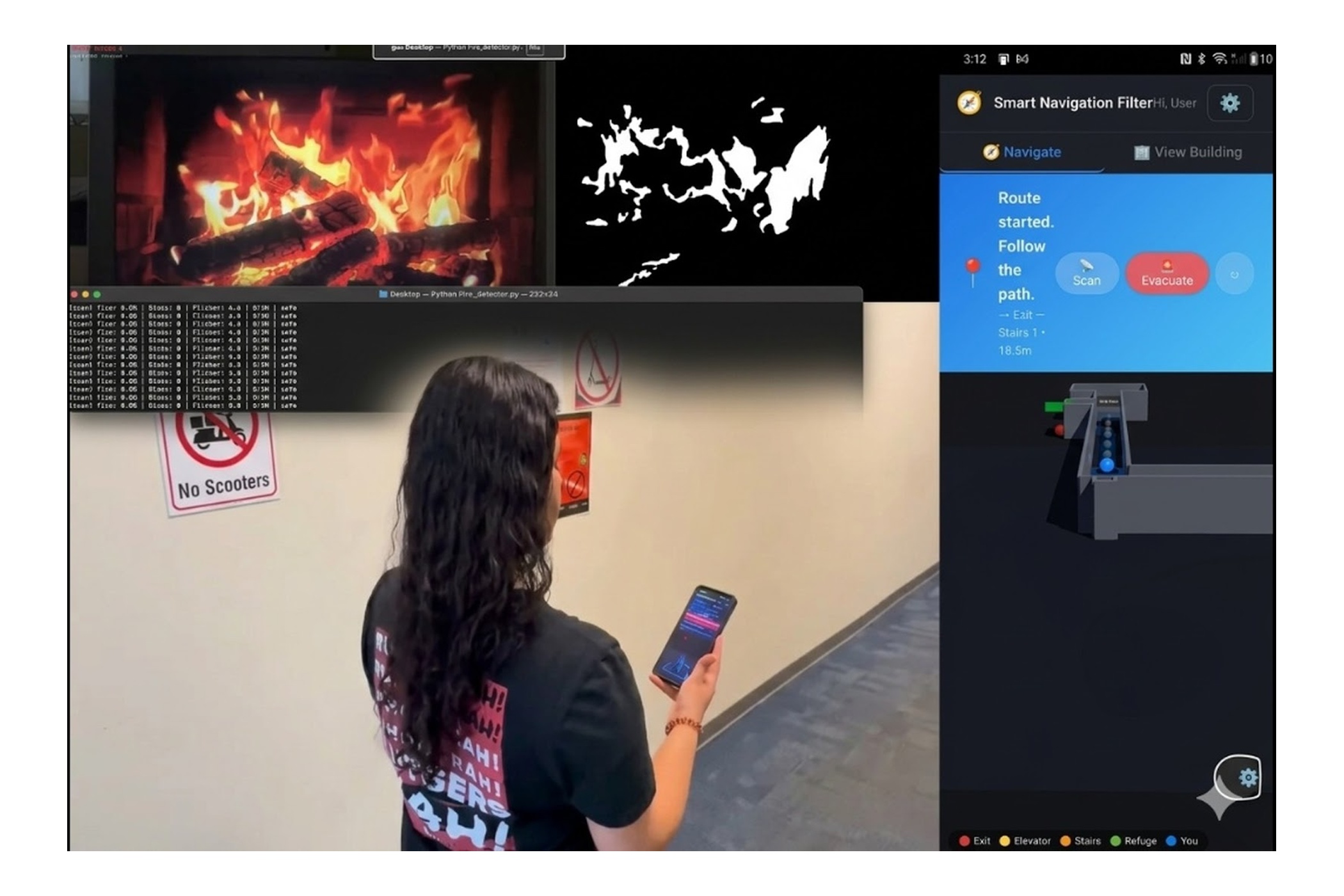
Project Motivation and Problem Statement Independent indoor navigation presents significant challenges for individuals with disabilities. In complex environments such as transit terminals or multi-story buildings, obstacles including long walking distances, inaccessible elevator interfaces, and crowded corridors create physical and psychological barriers to mobility. These challenges become life-threatening during emergencies such as fire evacuations, where standard exit routes rely on stairs, rendering them unusable for individuals with limited mobility. Existing navigation applications lack the granular, real-time data required to personalize routes based on specific disability profiles. There is a critical need for an integrated system combining accessibility awareness, indoor mapping, and real-time emergency guidance to ensure inclusive safety for all occupants. Engineering Approach and Methods The Smart Navigation Filter addresses this gap through a multi-layered technical approach. Physical building blueprints are converted into digitized 3D maps rendered using Three.js within a mobile application. A custom pathfinding algorithm, inspired by Micromouse maze-solving logic, is enhanced by a multi-variable cost function: Cost = Distance + Accessibility Penalty + Safety Risk + Turn Difficulty. By weighting these factors, the system automatically filters out inaccessible nodes including staircases and narrow corridors, based on the user's specific accessibility profile. Indoor localization is achieved through a network of Bluetooth Low Energy (BLE) beacons, providing real-time positioning data. Fire detection is implemented using a YOLOv8 (You Only Look Once, version 8) computer vision model running on a laptop or edge device, which analyzes live camera feeds for fire and smoke. Upon detection, the system communicates with Google Firebase, a cloud-based real-time database, to instantly propagate emergency status updates to all active users. Design Implementation The implemented prototype consists of a mobile Android application built with React and Capacitor, integrated with a physical BLE beacon network deployed in a dorm hallway environment. The software subsystem manages user accessibility profiles, 3D building visualization, and environmental metadata. A key design feature is the Dynamic Evacuation Mode, which triggers automatically upon fire detection. In this mode, the YOLOv8 model processes the live camera feed and, upon confirming a fire event across multiple consecutive frames to reduce false positives, writes a status update to Firebase Firestore. The mobile app listens to this database in real time and immediately assigns a maximum Safety Risk penalty to the affected zone, forcing the pathfinding algorithm to reroute the user to the nearest accessible exit. The system supports multiple accessibility modes including wheelchair routing, which excludes stairwells entirely and prioritizes elevator access. Results and Performance Evaluation Preliminary testing has validated the accessibility filter and fire detection pipeline. In simulated trials, the system successfully bypassed stair-only routes for wheelchair profiles, selecting longer but fully accessible paths via elevators. Fire detection tests using high-fidelity video simulations demonstrated a response time under two seconds from detection to route recalculation on the mobile app. The multi-frame confirmation threshold effectively eliminated false positives. Current evaluation focuses on BLE beacon signal stability, with expected positioning accuracy of 95% and reliable navigation through a variable hallway layout without manual intervention. Impact and Applications The Smart Navigation Filter provides a scalable, software-driven model for making large-scale public infrastructure more inclusive and safer for all occupants. By prioritizing the most vulnerable users during emergencies, the system improves the overall efficiency and equity of building evacuations. The modular architecture allows straightforward integration with Smart Building Internet of Things (IoT) sensors to automate door openers or summon elevators on behalf of the user. The fire detection subsystem can be extended to support additional hazard types, multiple camera zones, and integration with existing building alarm infrastructure. Ultimately, this project demonstrates that accessibility-aware design is not merely a convenience but a fundamental requirement for modern life-safety systems.