
Testbed for Autonomous Space Proximity and Rendezvous Operations (TASPRO)
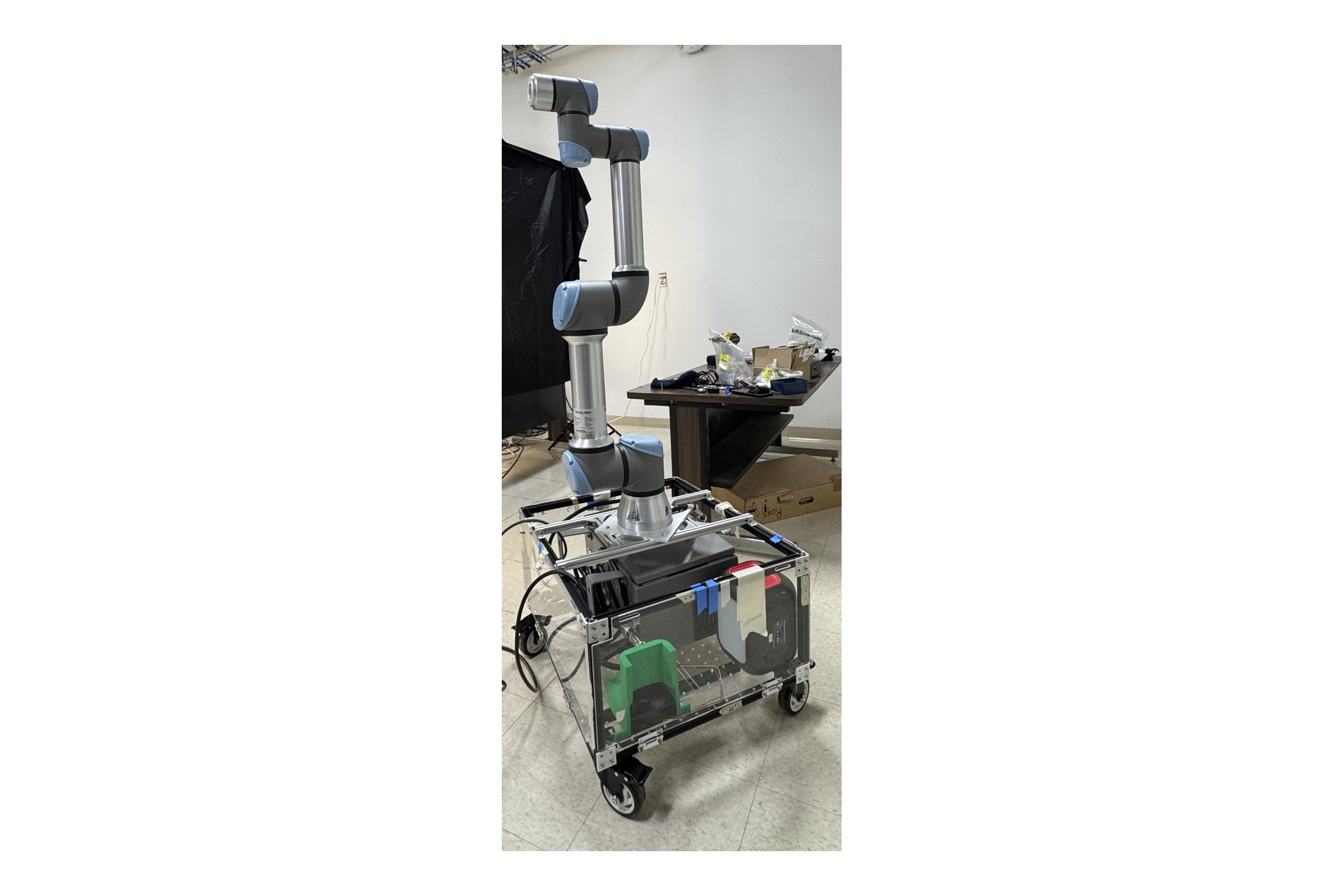
Autonomous space proximity and rendezvous operations (RPO) are critical for satellite servicing, debris removal, and on-orbit assembly, yet ground-based validation of these systems remains prohibitively expensive. This project presents the development of a low-cost, high-performance testbed designed to simulate spacecraft chaser-target interactions and validate control algorithms in a controlled laboratory environment. The Testbed for Autonomous Space Proximity and Rendezvous Operations (TASPRO) integrates a mobile robotic platform with a UR5e industrial robotic arm to replicate the relative motion and interaction dynamics of spacecraft in orbit. The system is built on a modular aluminum frame and incorporates a six-degree-of-freedom robotic arm capable of precise positioning and manipulation. A mixed AC/DC electrical power system supports system operation for extended durations, utilizing a lithium iron phosphate battery, an inverter, and dedicated power rails for both actuation and control components. The onboard Raspberry Pi 3B enables real-time control and data processing, while custom motor drivers facilitate mobility and system responsiveness. Thermal management is achieved through a forced-air cooling system that maintains stable operating temperatures for critical electronics under continuous use. The structural integrity of the platform was validated through finite element analysis, confirming a factor of safety suitable for the expected loading conditions. By providing a scalable and cost-effective alternative to traditional space simulation facilities, TASPRO enables rapid prototyping and testing of autonomous control strategies. This platform supports academic research and development in spacecraft guidance, navigation, and control, while lowering barriers to entry for experimental validation of emerging space technologies. Ultimately, TASPRO contributes to advancing the reliability and accessibility of autonomous space operations.